
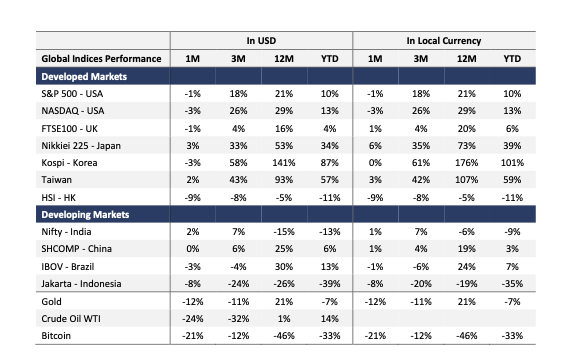
Two forces have been drivers of global markets in 2026: AI capex cycle and spike in oil prices triggered by the Iran war. Developed markets led by Korea, Taiwan and the US rallied hard on back of increasing AI capex, while emerging markets, weighed down by higher oil, underperformed. Both themes are likely to remain the key focus for markets in the near term.
Oil is likely to remain volatile
Oil volatility has been one of the market’s key focuses. The world is expected to consume 103.3 million b/d in 2026, growing at ~1.9% into 2027. Among major suppliers, Iran produces 3–3.5m b/d, and a total of 653,000 b/d was disrupted, driving oil prices above US$100. China, one of the largest consumers of oil with 2025 demand of 14.4m b/d, saw its demand collapse to 6.7m b/d in May’26 — which helped keep the price surge in check. Once the peace deal was signed between the US and Iran, oil fell sharply below US$70. Will China come back to restock, or is this a structural decline in demand? Could a re-start of the war once again create disruption? Oil is likely to remain volatile. The consensus forecast for oil prices in 2027 is US$75–80, which would be positive for India.
AI capex is driving global returns — are we mid-cycle or near the peak?
AI is a breakthrough technology and has become a massive driver of global capex and a defining theme for stock returns. The four big hyperscalers will spend ~US$600bn in 2026 and further US$800bn in 2027. This capex is for building AI infrastructure — the ‘AI factory’ — while application layer that will truly drive productivity gains and create new business models is next logical step over time. This technology cycle is unlikely to differ from previous ones such as railways, autos and the internet: there is frenzy during infrastructure build phase, and the adoption phase is not an extrapolation of it but something new that emerges. Between build-out and adoption, there is usually period of correction and consolidation before adoption plays out. The recent volatility in AI-related stock prices reflects the key question: are we mid-cycle, or closer to the peak of the infrastructure build-out phase?
Developed markets led by Korea, Taiwan, Japan and the US outperformed last quarter
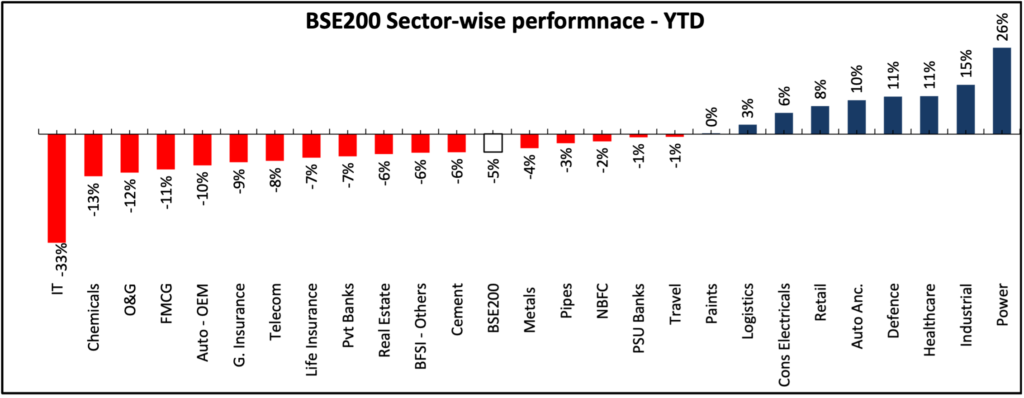
In India, the potential AI loser (IT services) and the AI winner (power) sat at the extremes of performance
Value is always emerging in some part of the market
Themes can be very strong drivers of stock prices; however, when the market gets fixated on a few of them, value often starts to emerge in another part of the market. Our job as bottom-up stock pickers is to continuously evaluate the right risk/reward, keeping both the theme and the fundamentals in mind.
India’s macro looks stable as oil risks recede
The Indian economy looked very vulnerable at the start of the war, with oil prices up to US$100 and an El Niño threatening deficient rainfall — raising concerns for fiscal targets, the balance of payments, the currency and inflation. However, with oil prices correcting below US$80, a lot of these risks are off the table. The monsoon is still a worry, but the overall macro scenario for India looks stable.
Consensus forecasts for GDP growth remain at 6.5% for FY27. The balance of payments started to emerge as a big risk as oil spiked, but the RBI’s intervention through FCNR(B) deposits and other measures — expected to attract anywhere between US$50–80bn of USD inflows — has reversed that risk. The monsoon is still a risk and inflation may spike up a bit in 2HFY27, but overall the economy looks stable and out of the way of a potential macro shock.
| FY20 | FY21 | FY22 | FY23 | FY24 | FY25 | FY26 | FY27E | FY28E | |
| Real GDP growth % | 3.9 | (5.8) | 9.7 | 7.6 | 7.2 | 7.1 | 7.7 | 6.5 | 7.0 |
| Fiscal deficit % of GDP | (4.6) | (9.2) | (6.8) | (6.4) | (5.6) | (4.8) | (4.4) | (4.3) | (4.3) |
| Current Account % of GDP | (0.9) | 0.9 | (1.2) | (2.0) | (0.7) | (0.6) | (0.6) | (1.5) | (1.2) |
| CPI growth % | 4.8 | 6.2 | 5.5 | 6.7 | 5.4 | 4.6 | 2.1 | 5.0 | 4.8 |
| 10-Year Note % – YE | 6.1 | 6.2 | 6.8 | 7.3 | 7.1 | 6.4 | 6.6 | 7.3 | 7.3 |
| USDINR – Average | 70.9 | 74.2 | 74.5 | 80.4 | 82.8 | 84.6 | 88.3 | 95.1 | 97.0 |
| INR depreciation % | (1.4) | (4.5) | (0.4) | (7.3) | (2.9) | (2.1) | (4.2) | (7.2) | (2.0) |
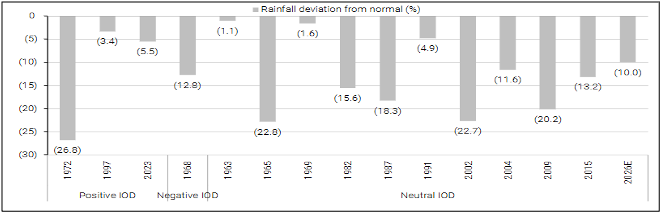
Weak monsoon, El Niño and inflation remain the key risk
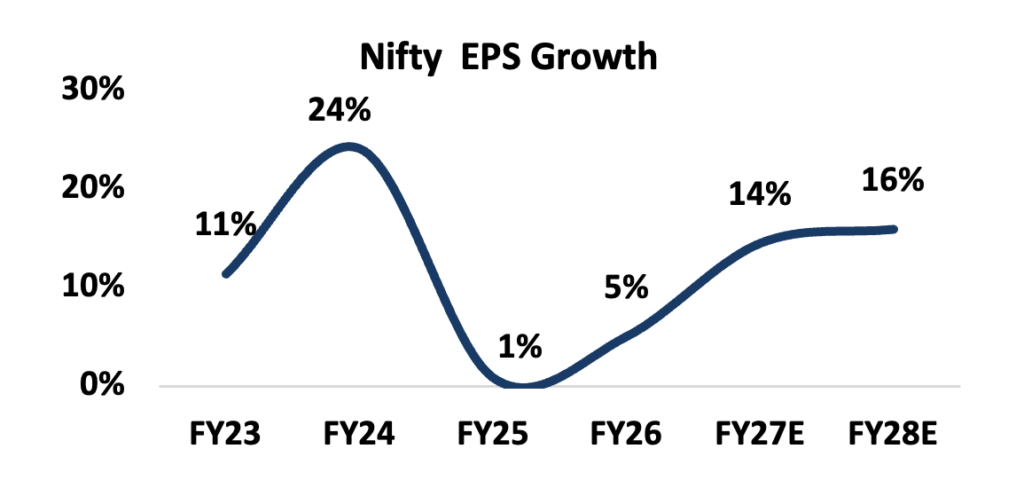
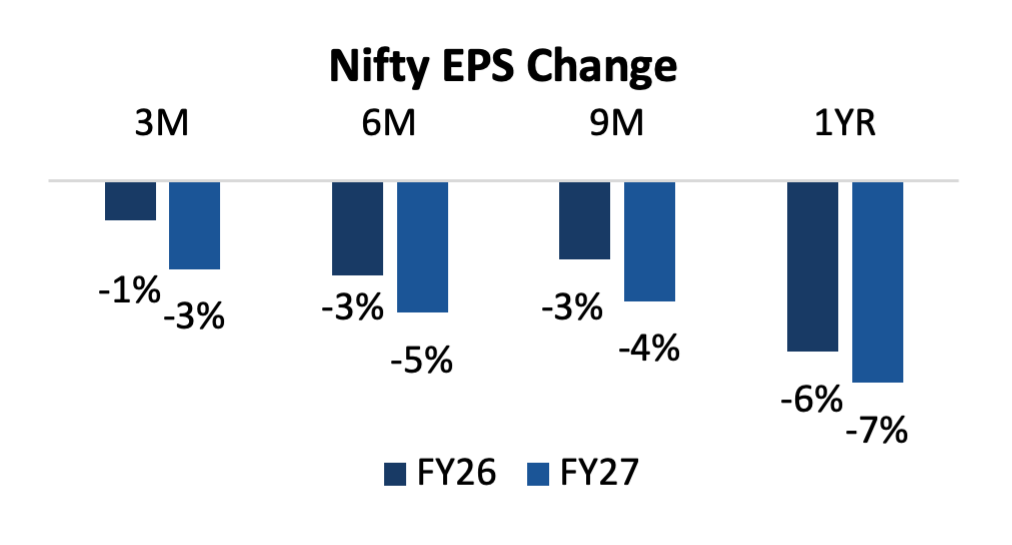
Consensus expects earnings growth of 15%
Downgrades cycle looks bottoming
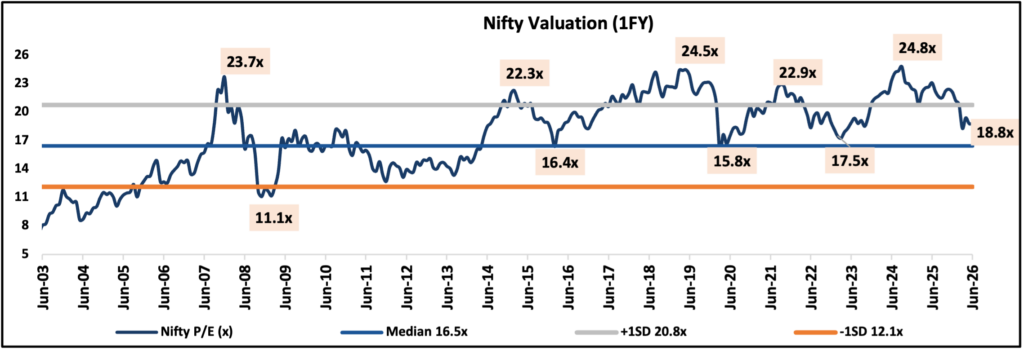
Nifty valuations are close to their 10-year average
n this note we have a closer look at Glenmark Pharma, a recent addition to our portfolio.
Glenmark Pharma — a repaired balance sheet and a pivot from generics to branded
Glenmark Pharma is a globally diversified pharmaceutical company with a balanced revenue mix across India, the US, the EU and the rest of the world (RoW). It is mainly a generic player, but after recent out-licensing success for a cancer drug it is pivoting its business model more towards R&D and branded drugs in India and RoW markets. Glenmark has been investing in innovative research for over two decades; while it has built some capability, there has been no commercial success so far. R&D is an expensive affair, and it had blown up the balance sheet. With the recent out-licensing deal with AbbVie for its lead drug ISB-2001 for US$700m, and the sell-down of the API business, the debt has been repaid and there is enough firepower to fund its R&D.
With the company’s balance sheet in good shape, the pivot in the business model can transform the company — with the caveat that success in R&D is always a risky affair. In this note we set out why we think Glenmark’s R&D has a better probability of delivering this time, and what the pivot towards branded drugs involves.
The BEAT platform, resulting from over a decades R&D effort
The company has been working on this platform since 2012, with the first success coming recently when it licensed its lead drug ISB-2001 to AbbVie for US$700m. BEAT (Bispecific Engagement of Antibodies based on the T-cell receptor) is a platform play that can churn out many drugs. It is a patented antibody-engineering platform that enables two different antibodies to pair together correctly — in simple terms, it can join two or more antibodies, and such pairs can be manufactured at scale. This enables a drug to target two or more cancer proteins and engage our body’s immune cells, such as T-cells and NK cells, to kill cancer cells.
The success of the BEAT platform is validated by its ability to reuse the same framework to generate new drugs. Because the underlying engineering framework is in place, one can swap in different targets — changing which cancer cells the drug locks onto, or which immune cells it recruits — to create an entirely new medicine. Glenmark has demonstrated this through:
- ISB-2001 targets multiple myeloma (blood cancer) using CD38 + BCMA + CD3.
- ISB-2301 is an early-stage solid-tumour asset built on the same BEAT chassis, via an evolved version called IMMUNITE.
- Additional programmes remain in the pipeline, all leveraging the same core platform IP.
Glenmark looks to file one new IND every year using the BEAT platform, starting with ISB-2301 at the end of 2026.
| Value driver | What it is | How to weigh it |
| Manufacturing moat | Single-step Protein A purification; ~94% correct pairing; standard CHO process | Durable, patented, lowers cost of goods — survives even if an individual asset fails |
| Repeatability (shots on goal) | ISB-2001 (heme) + ISB-2301 (solid tumour) from one engineering chassis | Evidence of a true platform vs. a one-hit wonder; more disclosed programmes = higher multiple |
| Format flexibility | 1+1, 2+1 avidity, trispecific; extensible to NK & macrophage engagers (IMMUNITE™) | Broadens the addressable pipeline across both blood and solid tumours |
| Validation flywheel | AbbVie’s $700M upfront paid for confidence in engineering, not just one molecule | Each new deal or data read-out re-rates the whole platform |
| Capital efficiency / optionality | Out-license single assets, retain the platform to generate more | Non-dilutive funding of the pipeline; Glenmark as sole backer is a concentration risk |
| Key risk | A platform is worth only as much as the assets it yields | Clinical failures erode it; rival heterodimerisation tech exists (KiH, CrossMAb, XmAb) |
ISB-2001 the lead drug candidate
ISB-2001 is a trispecific antibody, meaning it simultaneously targets three proteins: CD38, overexpressed on myeloma cells (the same target as blockbuster drug daratumumab); BCMA, another protein found heavily on myeloma cells and the most validated target in the field today; and CD3, a receptor on T-cells. Engaging CD3 drags a T-cell up against the cancer cell and triggers it to attack and destroy the tumour. By engaging two tumour-associated antigens simultaneously alongside CD3, ISB-2001 is designed to enhance avidity for myeloma cells while recruiting T-cell cytotoxicity — addressing both tumour escape and immune evasion.
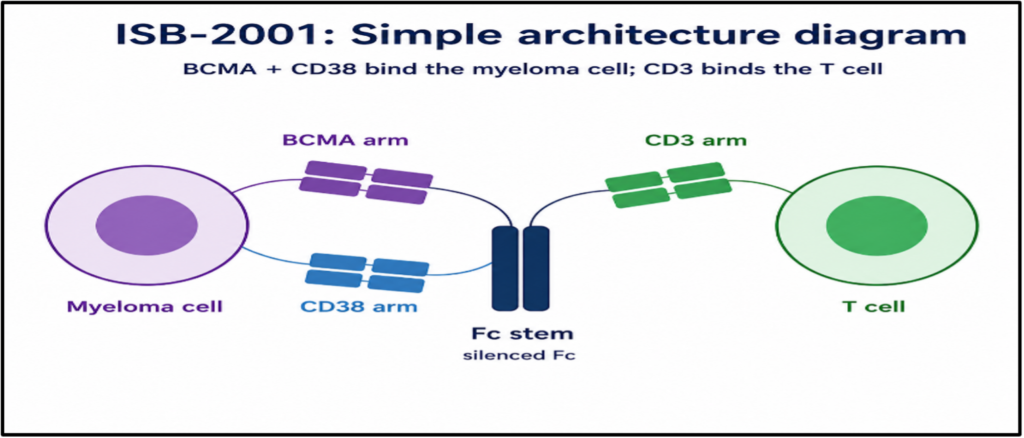
Early Phase 1 data is encouraging: overall response rate is 79%, with a clean safety profile. No grade >3 cytokine release syndrome (CRS) has been observed, no major neurotoxicity (ICANS), and no dose-limiting toxicity.
With Phase 1B on a larger patient population, the key measure to watch will be durability — for how long the drug suppresses the cancer, and how quickly it recurs. We would also watch for any adverse safety data in the Phase 1B read-out.
ISB-2001 has been granted Fast Track designation and Orphan Drug status. Positive Phase 1B data would trigger a milestone payment and increase the market’s confidence in the drug’s potential success.
The two competing drugs, J&J 5322 and IBI3003, are both in global Phase 1, behind ISB-2001.
In 2024, AbbVie entered into an out-licensing partnership with Glenmark for ISB-2001, providing US$700mn upfront and over US$1.2bn in contingent milestone payments.
New drug discovery is a high-risk business, and the success rate of a new drug reaching the market is very low. That said, the data released so far for ISB-2001 is encouraging, and we will watch for adverse data on both ISB-2001 and competing drugs.
ISB-2301, the next candidate targeting solid tumors
Where ISB-2001 tackles a blood cancer, ISB-2301 targets solid tumours — a space where no multispecific antibody has yet broken through. Solid tumours resist immune attack: they hide from immune cells, suppress the tumour microenvironment (TME) and vary their surface antigens. Existing immunotherapies (checkpoint inhibitors, CAR-T, bispecifics) mostly rely on a single mechanism and have largely failed here. ISB-2301 answers with three simultaneous killing mechanisms and dual immune-cell engagement. It is still a very early-stage programme, but it gives us more confidence in BEAT as a platform.
Glenmark’s generic business
Glenmark targets an increase in branded-generics revenue contribution from ~60% to ~70% of consolidated sales by FY2030, to be driven by leveraging its established commercial infrastructure in India and RoW markets through the launch of 4–5 in-licensed products over the next two years.
RoW business — Glenmark has assembled an oncology-focused in-licensed portfolio for the RoW and India markets, underpinned by structured infrastructure build-out and key-opinion-leader engagement to support ISB-2001 commercialisation post-approval over a 3–4 year horizon. Committed capex of ₹4,000–5,000mn is planned from FY27. We expect RoW sales to compound at 23% and grow to ₹67,000mn by FY30.
- Aumoletrinib (in-licensed from Hansoh Pharma for RoW): EGFR-mutant non-small-cell lung cancer; third-generation TKI competing with Tagrisso; peak sales potential of $100–150mn in 5–6 years.
- Trastuzumab Deruxtecan (in-licensed from Hengrui): HER2-positive solid tumours; ADC competing with Enhertu; peak sales potential of $250–300mn in 5–6 years.
- Envafolimab: subcutaneous PD-L1 checkpoint inhibitor competing with Keytruda; peak sales potential of $150–200mn in 5–6 years.
India business — Glenmark maintains a well-entrenched franchise across dermatology, respiratory and cardiovascular, and is pursuing incremental oncology penetration through disciplined in-licensing. We expect India sales to compound at 17% and grow to ₹70,000mn by FY30.
EU business — growth to be driven by market-share gains in existing geographies, new product launches, and commercial scaling of the innovative portfolio led by Ryaltris and Winlevi. We expect EU sales to compound at 10% and grow to ₹45,000mn by FY30.
US business — sales stabilised at approximately $350mn in FY25 following the resolution of legacy regulatory overhangs. The near-term growth agenda is anchored in respiratory and injectables, with Ryaltris already commercialised and a compelling pipeline of first-to-file (FTF) opportunities in respiratory. We expect US sales to compound at 11% and grow to ₹48,000mn by FY30.
Valuations imply substantial upside, against a defined downside
AT current price of Rs2300, Glenmark trades at 25x FY28 profits. Given the out licensing deal with AbbVie, the R&D platform can have a value of US$1-1.5bn at this stage of development which will be similar to other such early stage biotech players.
Successful launch of in licensed drugs in India and ROW markets can drive profit growth of 20-25% till FY30. If ISB2001 continues to move forward with positive data and further out licensing deals establish BEAT as a platform, R&D value can easily move upto US$3-3.5bn. Which can drive substantial upside from current levels.
R&D is always a risky affair, adverse data on the lead compound may result in de-rating of the stock; at 20x FY28 profits there is a 25% downside to the stock.
To conclude, the two themes, the AI capex cycle and oil, that have driven global markets through the first half of 2026 are likely to remain the focus in the second half as well. Both carry genuine uncertainty: whether the AI build-out is mid-cycle or nearer its peak, and whether oil’s retreat is a durable easing of demand or merely a pause. Rather than take a strong directional view on either, we stay alert to where the market’s fixation on these themes leaves value unpriced elsewhere.
This is the essence of bottom-up stock picking. We look for businesses with a long runway for growth available at reasonable prices, sizing each position with a clear view of both the upside and the downside we would accept if the thesis proves wrong. India’s stabilising macro backdrop provides a constructive setting for that search.