
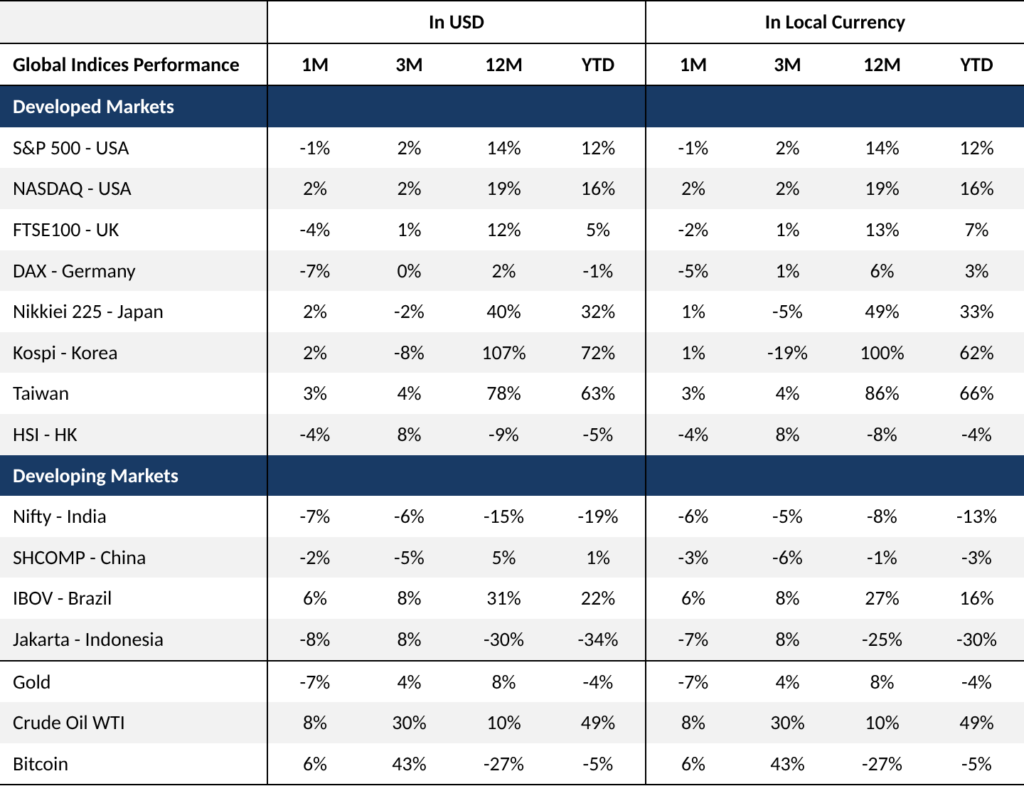
Global markets turned volatile in the September quarter, with three themes dominating sentiment: 1) rising bond yields, 2) rising energy costs and 3) continued capital expenditure on AI infrastructure. While the first two are adding to the risks for markets, the AI theme continues to keep bullish sentiment alive.
Developed market bond yields have risen across the curve. The move reflects not only the near-term impact of energy prices but also a longer-term worry about fiscal positions and government debt across developed markets. Energy costs have climbed on the recent escalation of the war with Iran and depleting petroleum reserves; higher energy costs raise inflation fears, which in turn put pressure on yields. AI capex, meanwhile, remains the driver of growth, and the hope of technology-led productivity gains is keeping bullish sentiment alive.
The history of technology cycles suggests that rising bond yields are usually what deflates a technology-led bubble, but the timing cannot be forecast with any accuracy. A de-escalation of the war with Iran could bring energy prices down and take some pressure off bond yields, at least in the near term.
Indian markets continued to underperform, declining 6% in USD terms over the quarter. FIIs remain net sellers of India in favour of markets offering AI-driven investment opportunities. Despite rising energy prices, India’s macro remains under control. Like global markets, Indian markets are increasingly divided: a few sectors continue to outperform while many are moving into value territory. For bottom-up stock pickers, this creates the opportunity to evaluate whether genuine value is emerging.
AI trade continues to dominate the market performance YTD
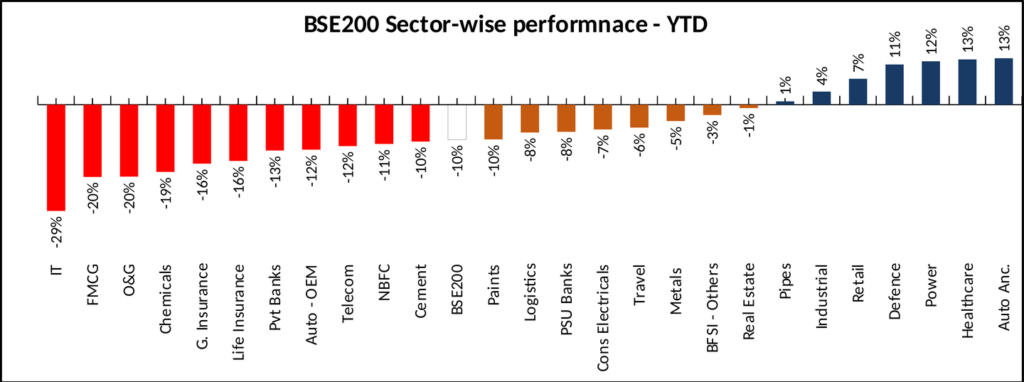
IT , FMCG and Financial continue to underperform
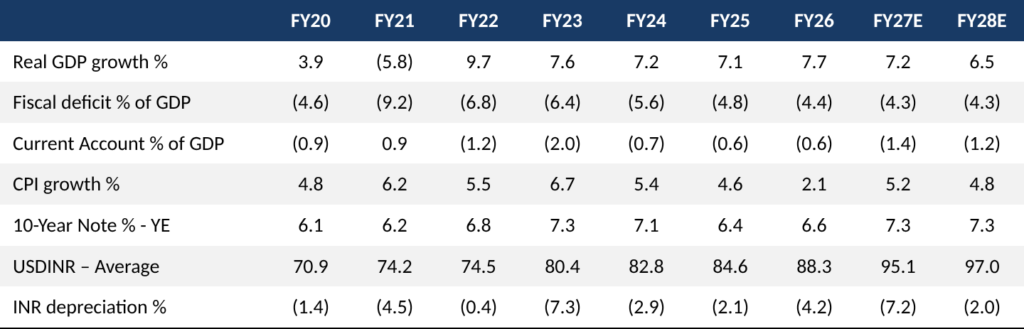
India’s fiscal position remains comfortable, but sustained oil prices above US$100 is a key risk
Despite the oil shock, India enters 2HFY27 with a relatively comfortable fiscal position. Tax collections remain healthy, while divestment and asset monetisation provide additional flexibility. Strong FCNR mobilisation has eased short-term balance-of-payments concerns. Inflation is a concern, mainly due to a likely increase in food prices, and consensus expects 50–75bps of rate hikes over the next 6 months. The rupee has depreciated 9% over the last 12 months, and its path is likely to be driven more by US bond yields and dollar movements.
India enters an election cycle from May 2027, which means major policy decisions may be deferred as period approaches. Overall, macro remains stable, but major structural reforms look unlikely in the run-up to elections.
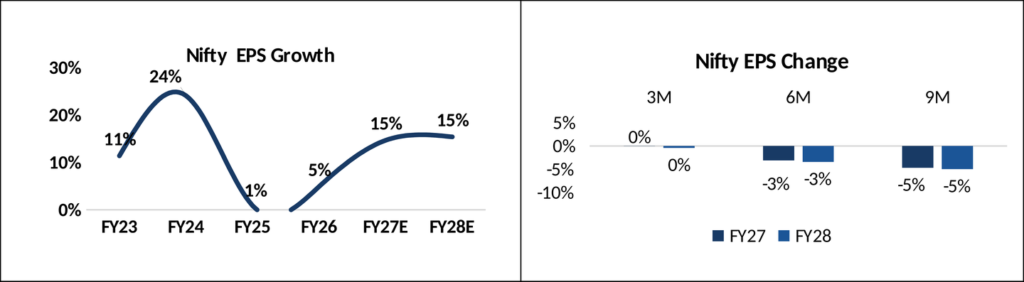
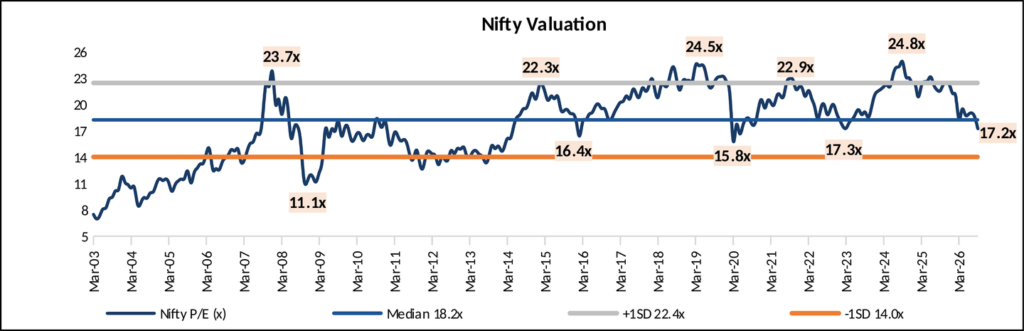
Nifty valuations are near or below their long-term average
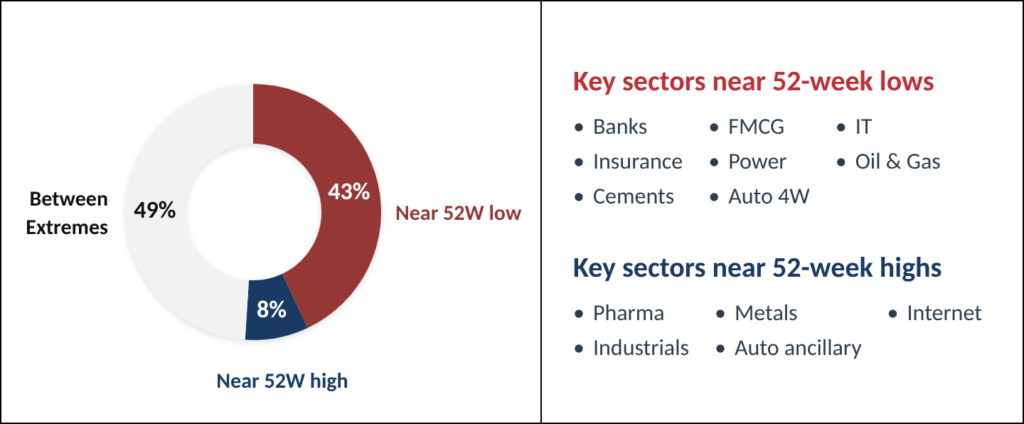
Market breadth remains weak – 43% of BSE200 stocks are near their 52-week lows
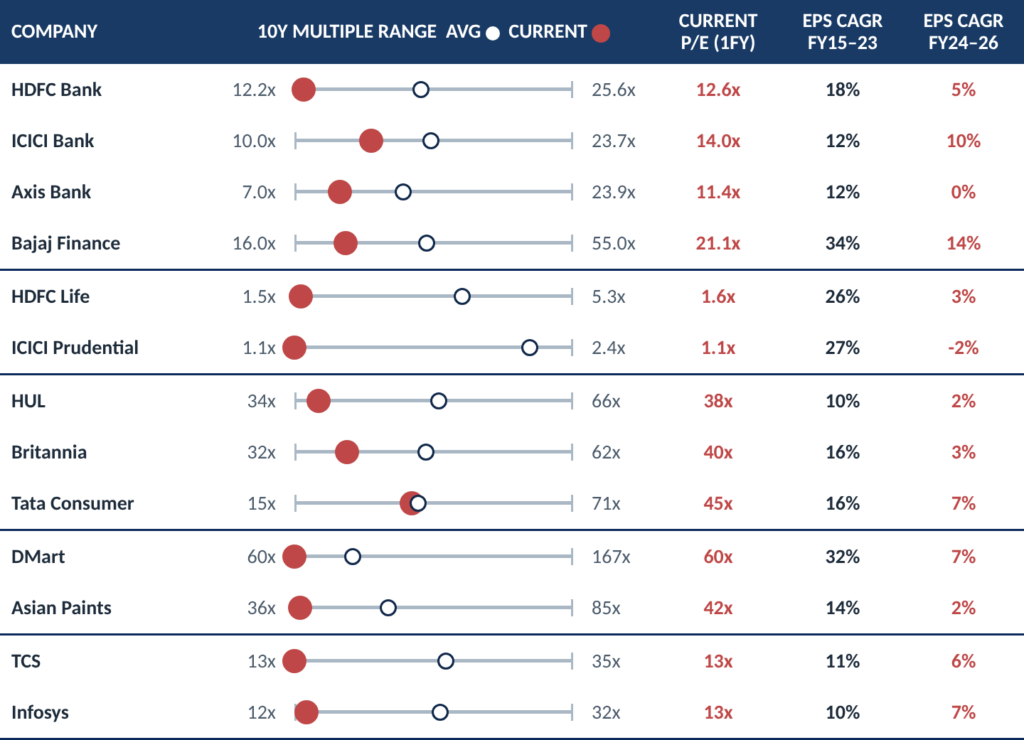
Growth sectors continue to re-rate while rest of the market tending towards trough valuations
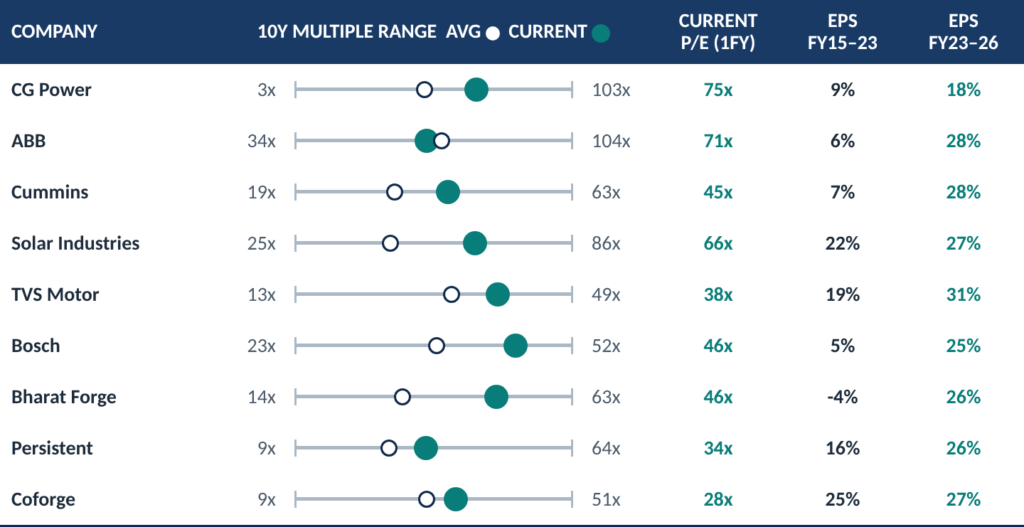
In this cycle growth is being rewarded and sectors with declining growth are being punished. Growth sectors are trading at high multiples and sectors with slowing growth are being pushed towards trough multiples. The key question for investors is to ascertain how much of this change is structural and how much is cyclical and could mean-revert. As bottom up stock pickers, we try to differentiate general structural decline from emerging value.
Slowing earnings growth has led to a sharp valuation de-rating
Strong earnings growth continues to command premium valuations
In this note, we take a closer look at housing finance companies
Large structural opportunity, but growth is constrained by bottlenecks
Land and housing are among the largest household assets and a natural source of collateral for credit. This is reflected globally in high mortgage-to-GDP ratios and the large share of mortgages in retail credit.
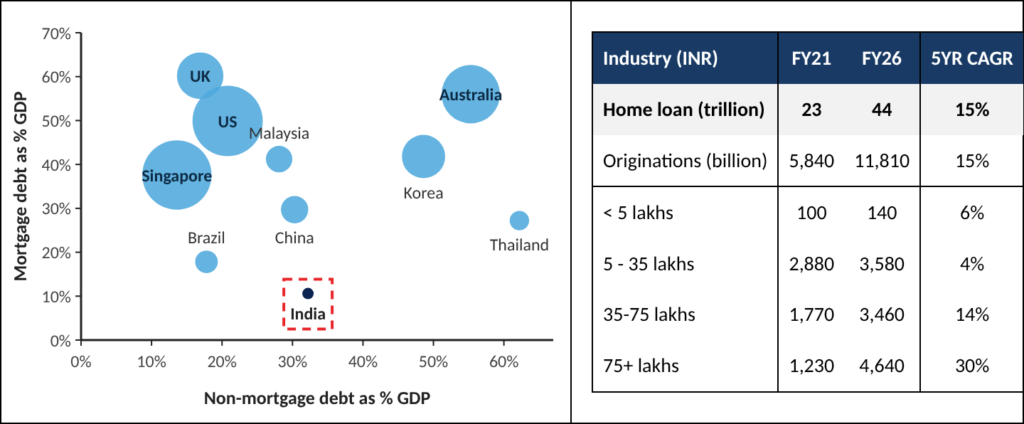
The Indian home loan market is US$500bn in size, about 26% of overall retail credit
The market has grown at a 15% CAGR over the last 10 years, yet mortgage penetration has barely moved over the past 20 years – from ~9% to ~11% of GDP – well below the 20–30% seen in other Asian economies and 50% in developed markets.
Over the last 5 years, the home loan industry grew at a 15% CAGR – but a closer look shows that growth has come from larger ticket sizes rather than volumes.
- Average ticket size grew at a 7% CAGR, whereas volumes grew by only 4-5% annually
- Loans below INR 35 lakh grew at just 4% CAGR, versus 30% CAGR for loans above INR 75 lakh
High regulatory costs are the key constraint
While the opportunity is large, faster growth will need reforms. High land, approval and regulatory costs make affordable housing difficult to build, pushing developers towards more expensive homes.
Despite these constraints, housing finance should continue to grow at a healthy double-digit rate
Urbanization, formalization and digitization of land records can revive affordable and mid-income segment on a structural basis. Rising affordability can give a cyclical fillip to the mortgage market.
Four factors drive success in housing finance
- Asset quality – strong underwriting discipline and collections keep credit costs low across cycles.
- Cost of funds – strong parentage and scale provide access to cheaper funding, allowing lenders to price competitively while maintaining healthy spreads and profitability.
- Diversification into higher-yield products – prime housing loans are a low-margin segment. Higher-yielding products such as LAP, self-employed loans and developer finance improve returns if managed at the right credit cost.
- Operating efficiency – scale, branch productivity and technology help lower operating costs and improve ROE.
HFCs typically generate 14–15% ROE, while players with lower funding costs, the right product mix, greater operating efficiency and strong underwriting discipline can deliver 17–18%.
The sector has seen a significant de-rating on concerns around slow disbursement growth, elevated balance transfers from increased competition, and pressure on spreads. Most stocks trade at 5yr trough multiples.
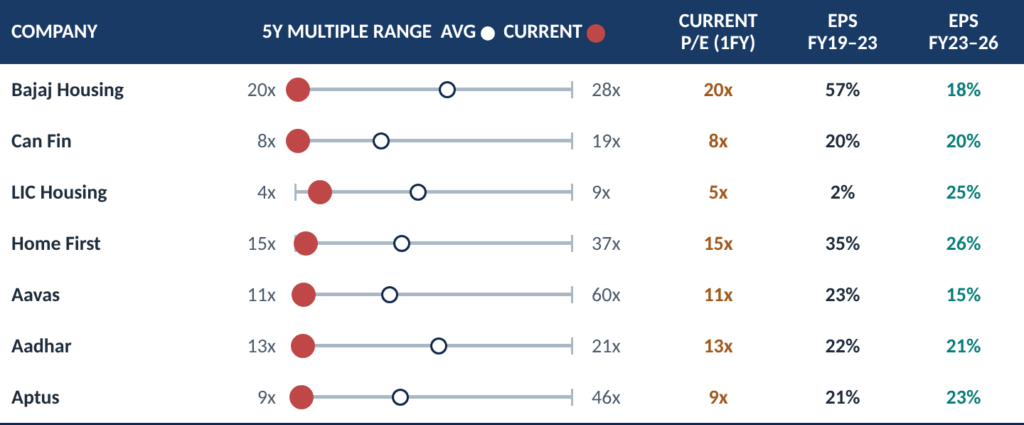
Looking for value buys, we own Can Fin Homes in our portfolio (Mcap INR 100 bn)
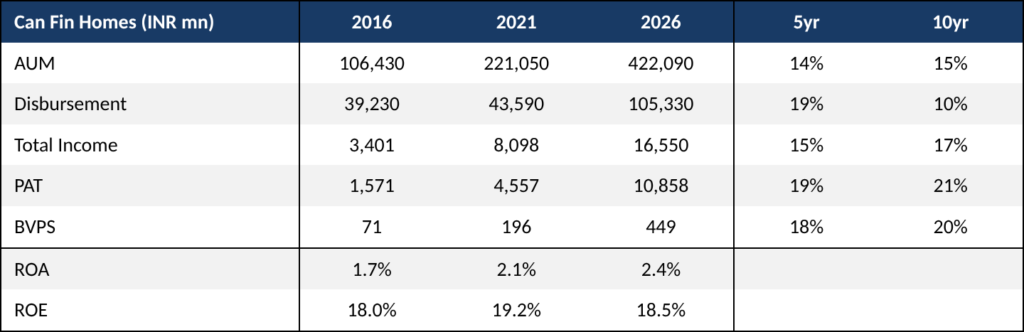
Can Fin Homes is a housing finance company 30% owned by Canara Bank with a strong presence in South India. It has a loan book of ₹430 billion, largely comprising loans with ticket sizes of INR 25 lakhs to 1 crore, a segment with a long runway for growth.
After a period of underinvestment during FY21–24, Can Fin shifted its focus back to growth under new management. Increasing distribution across country, investment in new tech platform, cost of fund advantage and a good underwriting culture should sustain a 13-15% growth and high teens ROE over the next 3 -5 years.
Growth – New loan disbursements remained flat during FY22–25, reflecting underinvestment during the period. Disbursements grew 23% in FY26, with management targeting 20–25% growth in FY27. However, AUM growth has lagged at 10–12% due to elevated loan run-offs and balance transfers. This gap should narrow as sustained disbursement growth gradually translates into faster AUM growth of 14-15%.
Margins have remained stable through the cycle. Its AAA rating gives it access to low-cost funding. A growing share of LAP and self-employed loans should also help maintain margins.
Credit costs remains a key strength. Cumulative write-offs have been only INR 180 million since inception, and credit costs have historically stayed low at 10–20bps, reflecting conservative underwriting.
Opex – Cost-to-income ratio increased from 17% during FY23–25 to 19.5% recently, due to investments in new branches and technology. As AUM grows and company gains scale, this should decline to 18% over medium term
ROA and ROE – Over the last 10 years, it has maintained 2-2.2% ROA and 18-20% ROE – reflecting funding cost advantage, prudent underwriting and operating efficiency. Tier 1 capital stands at 28%, providing sufficient capital to support future growth without the need for equity dilution.
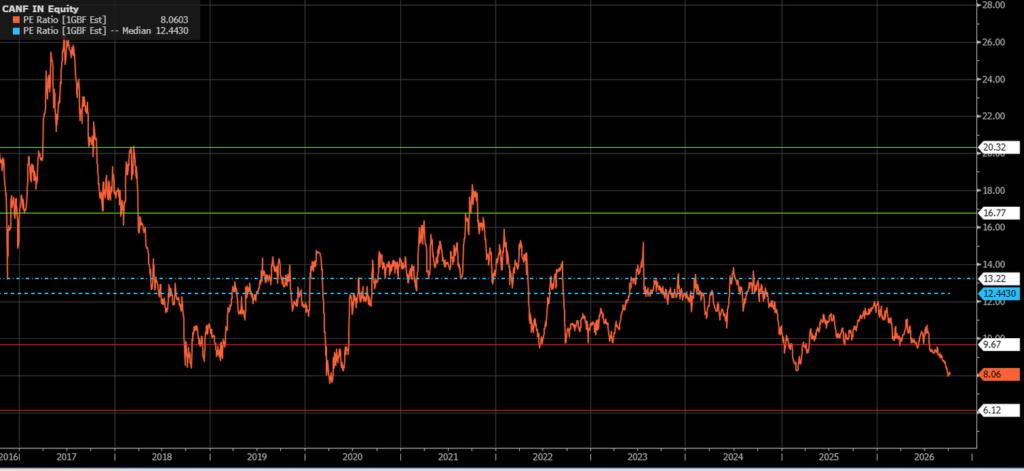
The market is currently not excited by a 15% growth story, and valuations reflect this. Can Fin trades at ~1.3x FY28 BVPS / ~8x FY28 EPS – 10-year trough multiples.
Conclusion
This quarter underlined how two-tiered markets have become. Globally, AI-linked capital spending keeps sentiment afloat even as rising bond yields and energy prices build risk beneath the surface. In India, a handful of sectors command premium valuations while a large part of the market, with 43% of the BSE200 near 52-week lows, trades at or near trough multiples.
We can’t forecast when yields, oil or the AI cycle will turn. We don’t need to. Our job is to separate what is structurally broken from what is simply out of favour. Periods like this test patience, but they are also when bottom-up research tends to find its best opportunities. At East Lane Capital, we remain focused on identifying and investing in quality businesses whose earnings power is not fully reflected in their prices.